
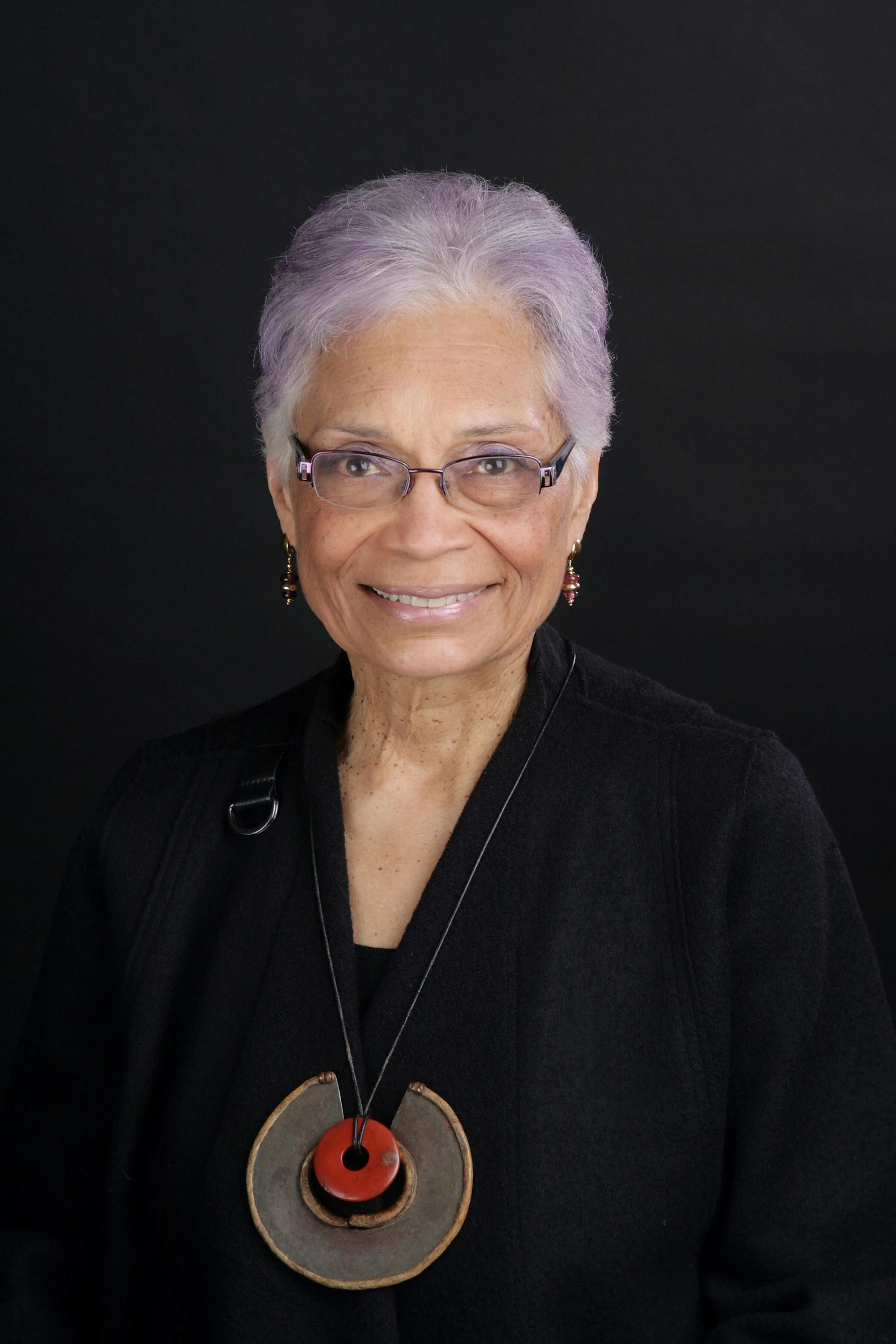
Dr. Sharon Egretta Sutton is Professor Emerita of Architecture, Urban Planning and Design, and Social Work at the University of Washington, where she taught from 1998 until her retirement in 2016 and founded the Center for Environment Education and Design Studies (CEEDS) . Born in Cincinnati, Ohio in 1941, she holds five academic degrees: a bachelor's in music from the Hartt College of Music, a Master of Architecture from Columbia, and a Master of Philosophy, Master of Arts and Ph.D. in environmental psychology from the City University of New York .
Her route into architecture was not the usual one. She trained as a French horn player, studying with Gunther Schuller at the Manhattan School of Music, and worked professionally in New York , including more than 1,000 performances in the original Broadway cast of *Man of La Mancha*, and engagements with Sol Hurok Attractions and the touring orchestras of the Bolshoi, Royal, Leningrad and Moiseyev ballets . She enrolled at Parsons School of Design in 1967, transferred to Columbia's architecture school, and was licensed to practise in 1976 , the twelfth African American woman in the United States to become a registered architect . She is also a practising printmaker whose fine art is held in the Library of Congress .
Her academic career has been a sequence of firsts. She taught at Pratt Institute, Columbia and the University of Cincinnati before joining Michigan in 1984, where she became the first African American woman promoted to full professor of architecture in 1994 and the second elected a Fellow of the American Institute of Architects in 1995 . At Michigan she founded The Urban Network, an urban design programme for youth in Detroit that ran from 1989 to 1997 and became the practical basis for her community-based model . She then moved to Washington, and in 2023 became the first African American to receive the AIA/ACSA Topaz Medallion for Excellence in Architectural Education , the profession's highest honour for teaching , having already received the AIA's Whitney M. Young Jr. Award in 2011, the ACSA Distinguished Professor Award, Medals of Honor from the AIA's New York and Seattle chapters, and a Lifetime Achievement Award from the Michigan Women's Hall of Fame .
Her six books trace a single argument about the built environment as both a source of oppression and a site of transformation. *Learning Through the Built Environment* (1985) and *The Urban Network* (1989) grew from her work with young people; *Weaving a Tapestry of Resistance* (1996) theorised the places, power and poetry of a sustainable society; *The Paradox of Urban Space* (2011), co-edited with Susan P. Kemp, examined inequality and transformation in marginalised communities; *When Ivory Towers Were Black* (Fordham, 2017) reconstructed how Columbia's architecture school recruited and retained minority students during the affirmative action era , a story she lived as one of those students; and *Pedagogy of a Beloved Commons* (Fordham, 2023) sets out a practical curriculum for place-based activism . She remains Distinguished Visiting Professor at Parsons School of Design and Adjunct Professor at Columbia, and continues to write and exhibit.
Dr. Sutton's career has consistently refused the separation between design excellence and social justice that the profession long treated as a given. She was the twelfth African American woman licensed to practise architecture in this country, the first promoted to full professor, the second elected to AIA fellowship , and at every one of those milestones she used the position to argue that the built environment is a source of oppression for communities of colour as well as a possible instrument of their empowerment. That argument is now mainstream in architectural education. It was not when she began making it.
The practical record behind the argument is what gives it weight. The Urban Network ran for eight years in Detroit, putting young people through a real urban design programme rather than a simulation. CEEDS at Washington built the same model into a university centre. *When Ivory Towers Were Black* is not a polemic but an institutional history, reconstructed from archives, of how one architecture school actually recruited and retained minority students during the affirmative action era , written by someone who was in the room.
Manuscripts in architecture and planning fail in recognisable ways: a community-engagement claim is asserted without evidence that the community shaped anything, a design proposal is presented as socially beneficial without any account of who benefits, or a historical argument rests on a single institutional archive. Dr. Sutton has spent fifty years testing exactly those claims against evidence, and she brings that discipline to the manuscripts APC reviews.
The APC Leadership Team American Publication ConsultantsTell us about your manuscript and we will match you with the right expert from our team.
Get A Free Quote