
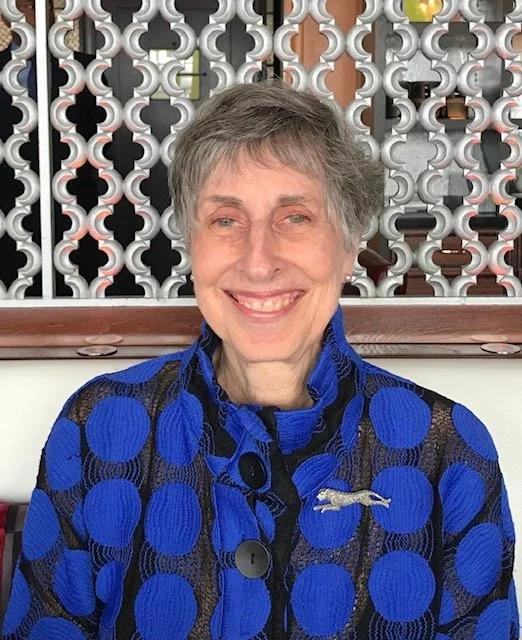
Prof. Irene J. Winter is William Dorr Boardman Professor of Fine Arts, Emerita, at Harvard University, where she taught in the Department of History of Art and Architecture from 1988 until her retirement in June 2009. She chaired the department from 1993 to 1996, served on the Faculty Council from 2006 to 2009, and was cross-appointed in the Department of Near Eastern Languages and Cultures .
She came to art history through anthropology, and the route shows in her work. She took her A.B. in Anthropology at Barnard College in 1960, an M.A. in Near Eastern Languages and Literature at the University of Chicago in 1967, and a Ph.D. in Art History at Columbia in 1973, with a dissertation on North Syria and ivory carving in the early first millennium B.C. She excavated in Iran from 1967 to 1974 at Godin Tepe and Hasanlu, taught at Queens College CUNY and the University of Pennsylvania before moving to Harvard, and was Slade Professor of the History of Art at Cambridge in 1996–97 .
Her scholarship is widely credited with moving ancient Near Eastern visual culture from description toward interpretation. Rather than treating objects as illustrations of texts, she asks about the cultural and historical contexts in which art is produced and about art as a medium for social and ideological forces , work that spans Mesopotamian art, architecture and aesthetics, Neo-Assyrian relief sculpture and seals, Phoenician and Syrian ivory and bronze production, inter-polity connections from the Aegean to Iran, and gender in the ancient Near East . Her collected essays appeared as *On Art in the Ancient Near East* (Brill, 2010, two volumes), and twenty of her students honoured her with *Ancient Near Eastern Art in Context: Studies in Honor of Irene J. Winter by her Students* (Brill, 2007) .
She received a MacArthur Prize in 1983 and was elected to the American Academy of Arts and Sciences in 1999 and the American Philosophical Society in 2016. She was a Radcliffe Institute Fellow in 2003–04, delivered the fifty-fourth A.W. Mellon Lectures in the Fine Arts at the National Gallery of Art in 2005 under the title 'Great Work: Terms of Aesthetic Experience in Ancient Mesopotamia', and received the Barnard College Medal of Distinction in 2009 . She has also served on the Iraq Task Force of the Archaeological Institute of America, working on the recovery of looted material, the control of site plundering and the preservation of the region's cultural heritage .
Prof. Winter's contribution to her field is not simply a body of scholarship but a change in how the field argues. She insisted that a Mesopotamian relief or seal is evidence of how a society thought about power, gender and abundance , not merely a datum to be dated and catalogued , and she brought anthropological method and art-historical theory to material that had too often been left to connoisseurship. That insistence is now so widely shared that it is easy to forget how hard it was to establish.
Her generosity as a mentor is documented in the most literal way possible: her students published a Festschrift in her honour while she was still teaching. Her service on the Iraq Task Force, on looted antiquities and site protection, shows the same conviction applied outside the seminar room , that objects matter because the cultures that made them matter.
Manuscripts in art history and archaeology fail for particular reasons: an object is over-interpreted, a corpus is under-controlled, or a theoretical frame is imported without being tested against the material. Prof. Winter has spent a career holding those two halves , evidence and argument , in the right relation, and she brings that discipline to the manuscripts APC reviews.
The APC Leadership Team American Publication ConsultantsTell us about your manuscript and we will match you with the right expert from our team.
Get A Free Quote